Recently, the IEEE Council on Superconductivity (IEEE CSC) officially announced that the 2025 and 2024 annual “Best-contributed Paper” — the Van Duzer Prize Award — have been granted to the “Jingtian Magnet” paper published by the Energy Singularity team and the SPARC TFMC magnet paper published by the CFS and MIT teams, respectively.
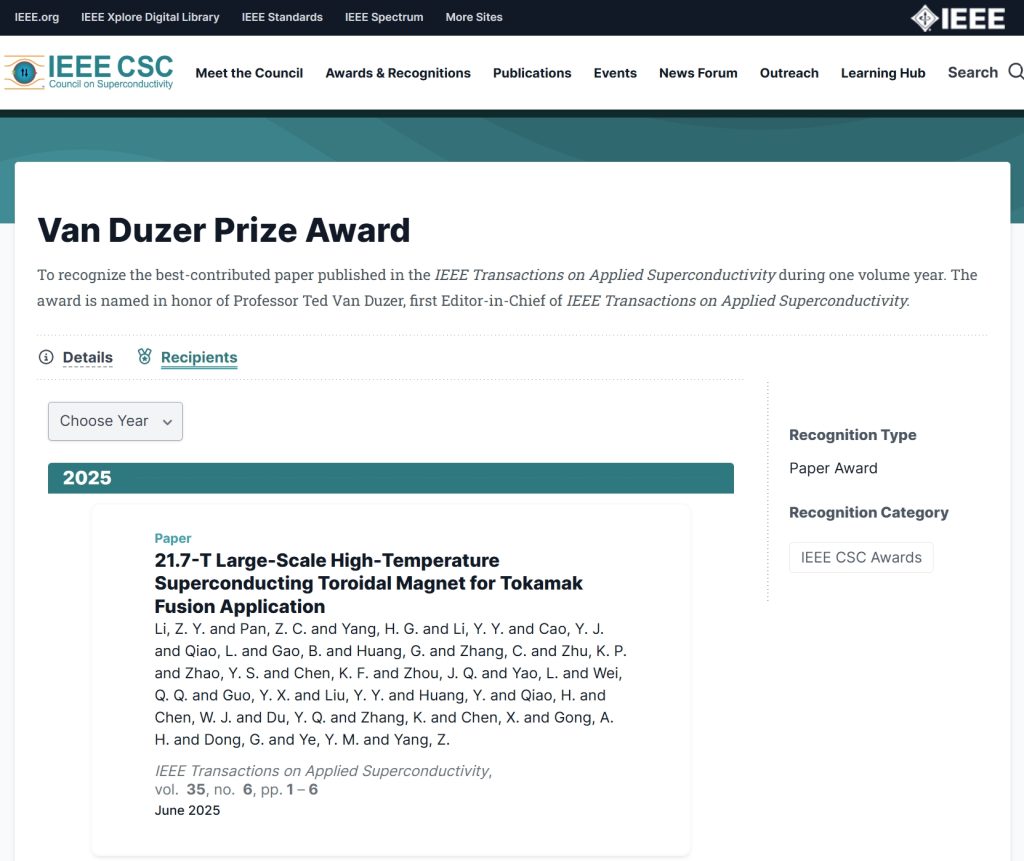
Established by IEEE CSC, the Van Duzer Prize Award aims to select the “best-contributed paper” published in the IEEE Transactions on Applied Superconductivity (IEEE TAS) during a given volume year. Named after Professor Theodore Van Duzer, the first Editor-in-Chief of IEEE TAS and a renowned expert in superconducting electronics, it is one of the most influential paper awards in the international field of superconductivity.
Energy Singularity’s award-winning paper, titled “21.7-T Large-Scale High-Temperature Superconducting Toroidal Magnet for Tokamak Fusion Application,” was published in IEEE TAS in 2025. The paper systematically reports on the design, fabrication, and high-field experimental results of the large-scale high-temperature superconducting toroidal field (TF) magnet — the “Jingtian Magnet” — independently developed by Energy Singularity, demonstrating its potential application in tokamak fusion devices. The Van Duzer Prize Award recognizes the paper’s outstanding comprehensive performance in terms of technical excellence, long-term academic impact, and archival integrity.
Previously, the Jingtian Magnet was included in the International Atomic Energy Agency’s (IAEA) World Fusion Outlook 2025 report as one of the representative achievements in China’s fusion field. Winning this prestigious award once again marks the recognition of the Chinese team’s research in the critical field of high-temperature superconducting fusion magnets by authoritative international organizations. It further consolidates Energy Singularity’s leading position in the field of high-temperature superconducting tokamak technology.