Energy Singularity announced the successful completion of three performance tests of its independently developed cryogen-free high-temperature superconducting (HTS) insulated magnet. The magnet generated a central magnetic field of 20 T, 23.1 T, and 26.7 T respectively. This magnet was designed for a 25 T target central field. In the third test, after achieving stable operation at 25.5 T, the team further ramped the magnet to 26.7 T. At this point, the current density exceeded 570 A/mm², with a calculated peak field of over 27.5 T in the windings.
The magnet consists of 14 single pancakes, with an outer diameter of 140 mm and a winding diameter of 30 mm per pancake. Its initial operating temperature is 6 K. The successful development and operation of this magnet have set two new world records:
- The highest magnetic field ever achieved by a cryogen-free HTS magnet;
- The highest magnetic field ever achieved by an insulated HTS magnet.
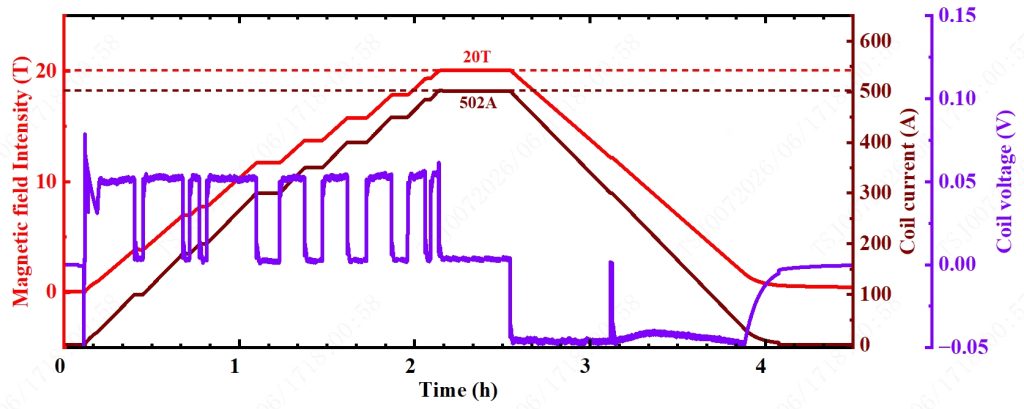
In the first test, the magnet was ramped up to 20 T and operated stably before being safely ramped down
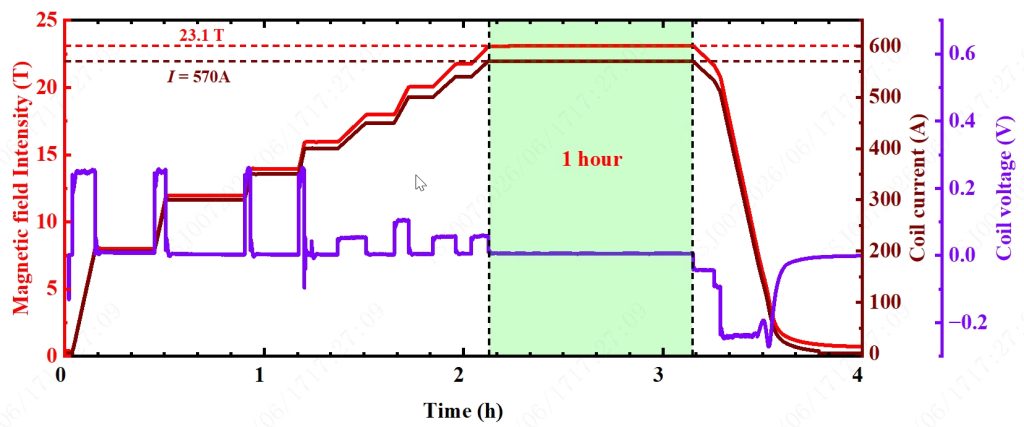
In the second test, the magnet was ramped up to 23.1 T and operated stably before being safely ramped down.
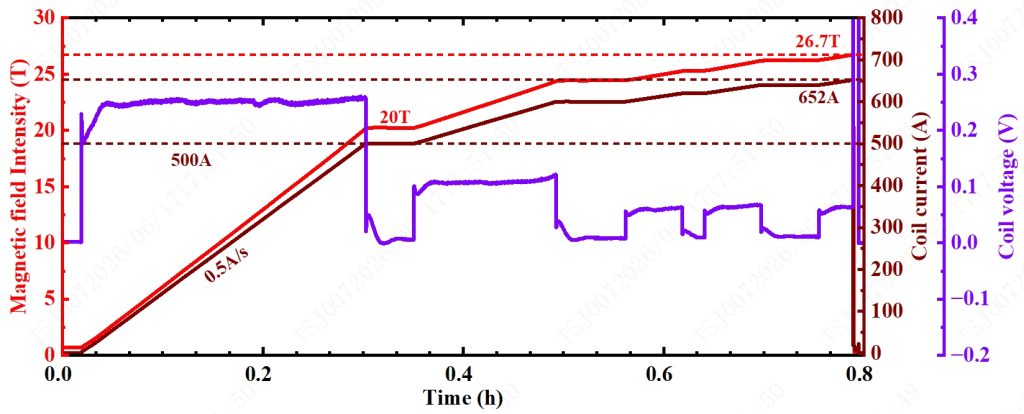
In the third test, after achieving stable operation at 25.5 T, the magnet was ramped up to 26.7 T
Beyond breaking records in magnetic field, this magnet offers several key innovations and advantages over existing HTS magnets:
- Cryogen-free operation: All cooling is provided by a single GM cryocooler through pure conduction-cooling, eliminating the need for liquid helium. This significantly simplifies the auxiliary systems required for magnet operation and substantially reduces operating costs.
- Insulated structure: The team overcame the conductor insulation challenge at extremely high magnetic fields and adopted an innovative insulated design. Compared with no-insulation (NI) magnets, this dramatically increases the ramping speed. The magnet can be ramped to 20 T in just 16 minutes, greatly reducing user waiting time and improving magnet utilization efficiency.
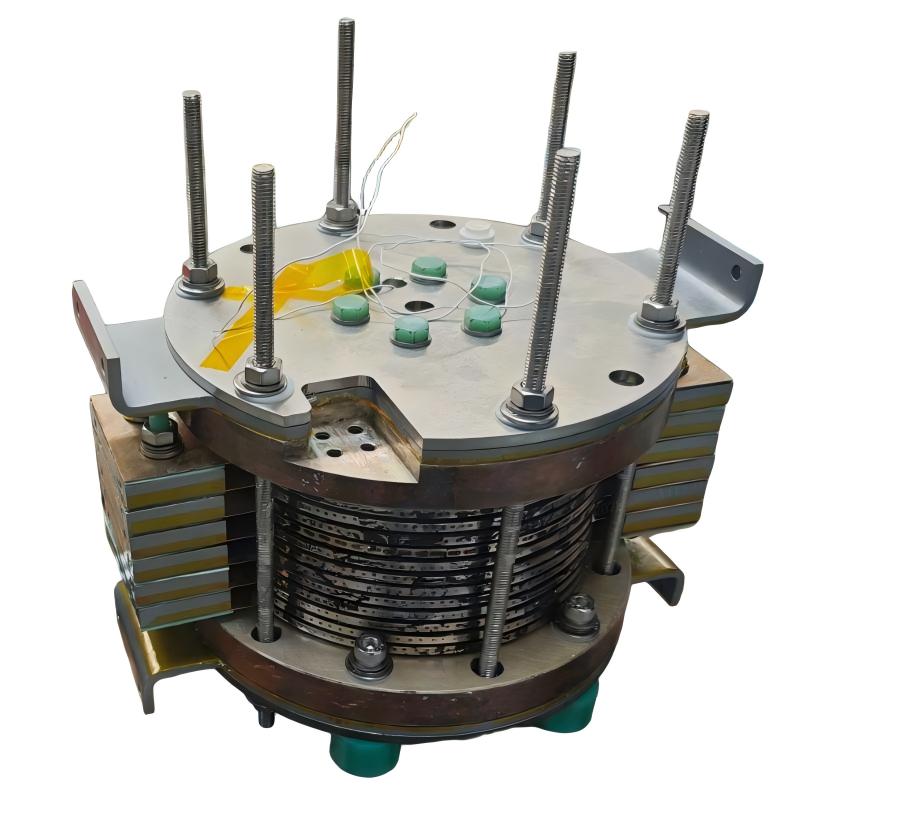
Magnet photo
The simultaneous application of an insulated structure and cryogen-free operation in an HTS magnet exceeding 20 T represents a world first. The successful development and operation of this magnet marks another breakthrough for Energy Singularity in HTS magnetic confinement fusion R&D and engineering practice, ensuring the company’s continued leadership in HTS magnet technology.
The magnet will first be deployed in Energy Singularity’s independently developed HTS material production and performance testing platform. Thanks to its insulated structure, the magnet fundamentally avoids the problem inherent in no-insulation magnets where magnetic field changes lag behind current changes. This magnet can also be applied to scenarios requiring extremely high magnetic field uniformity, such as NMR (Nuclear Magnetic Resonance), PPMS (Physical Property Measurement System), etc.